2026
Pusti maški mira / Leave the Cats Alone
September 4, 2026
Leave the Cats Alone: color, movement, and personal experience
Location
Gradska galerija Fonticus, Grožnjan
Documentation
2 photos
Overview
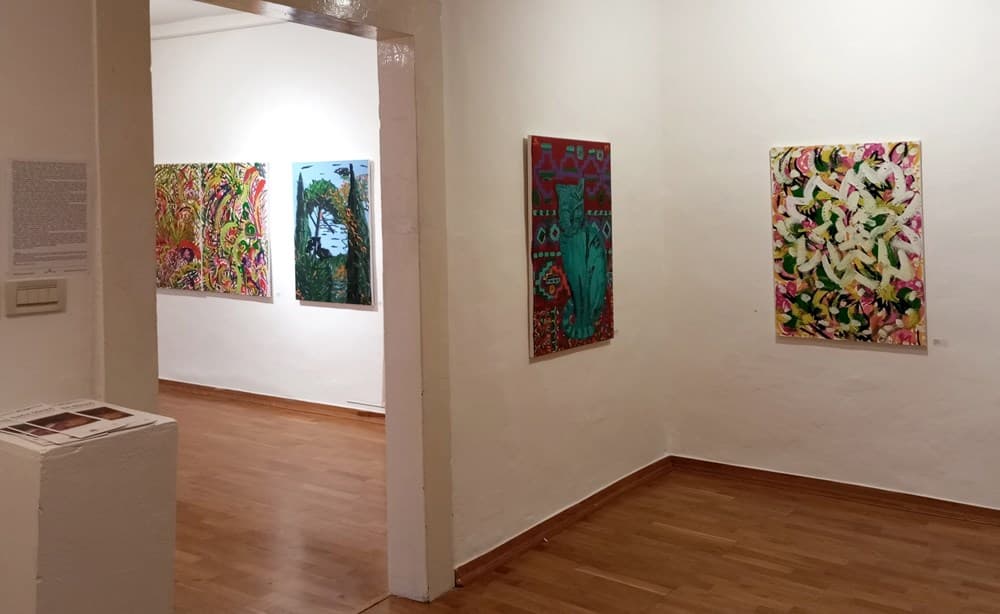
Saša Mesić's solo exhibition opened on September 4, 2026, at the Fonticus City Gallery in Grožnjan alongside Atanas Botev's “Saving the Testimony.” Although the two presentations began with different subjects and visual languages, both were rooted in a personal response to reality: Botev addressed memory and threatened heritage, while Mesić presented a new cycle of paintings devoted to cats. Curator Eugen Borkovsky introduced the exhibitions to the public.
The Croatian title “Pusti maški mira” draws on a familiar phrase from the coastal vernacular and immediately sets the cycle's direct, playful tone. Painted in acrylic on canvas, these works do not portray cats descriptively. Instead, they appear as distilled silhouettes, traces, signs, and glimpses caught in motion—recognizable enough to retain a figurative anchor, yet free enough for the compositions to initially approach abstraction.
Expressive lines lead the eye across the surface with the immediacy of a rapid drawing or sketch. Around them, vivid fields of color and texture create a rhythm that feels both painterly and physical. Some figures seem to suspend a single instant; others register movement itself. Form is not contained by a fixed outline but remains alive in its relationship with color and gesture.
This openness also reflects Mesić's working process. A painting may begin with a stain or a stroke, then develop through shifts in technique, chromatic relationships, and form. Rather than following a predetermined scheme, she responds to the rhythm of the painting as it takes shape. The visible stages of that process are not merely preparation for a final image; they are essential to its meaning and energy.
Across history, cats have occupied changing roles, moving between reverence, suspicion, and the intimacy of domestic companionship. In this cycle, that cultural history remains in the background: the animal is not an illustrative subject, but a sign through which the artist explores what she sees, remembers, and experiences. The real feline world and personal imagination deliberately overlap, allowing viewers to discover their own relationships, moods, and narratives in the paintings.
Borkovsky characterized the works as “screens of energy.” Their intense palette, gestural handling, and almost graffiti-like notation connect them with the visual sensibilities of underground culture, pop culture, and street art. Yet the cycle's force lies in more than visual exuberance: behind the playful figures is a serious question about how immediate experience becomes a painterly sign.
Within the shared space of Fonticus, two distinct perspectives on lived reality came together. In contrast to Botev's engagement with ruins and collective memory, Mesić constructs a world of color, spontaneity, and movement. Both approaches remain open to the audience, inviting each viewer to build a personal reading from the fragments offered.
Gallery
Photos: Galerija Fonticus